







An interview with SES speaker Cindy Krum.
Earlier this month Ron Jackson posted about an interesting session at Search Engine Strategies’ San Jose Show, taking place August 18-22. The session, titled “Mobile SEO: Death of the ‘.mobi'”, suggests that web developers shouldn’t create a mobile version of their web sites. Instead, they should make their “one web” site work across traditional and mobile platforms.
So when SES asked me if there was anyone presenting at the show that I’d like to interview, I quickly jumped on the opportunity to get some answers from one of the speakers on the panel, Cindy Krum of Blue Moon Works, Inc. (OK, so first I asked to talk to Google but that didn’t go anywhere 🙂 )
Regardless of whether you think .mobi has a future or not, Krum provides a compelling argument that designing a mobile-only web site is shortsighted, and companies should instead focus on making their main web site mobile-friendly.
Domain Name Wire: Why do you think .mobi isn’t necessary?
Krum: I have always been philosophically against device-specific TLDs because I believe that they are short sited, and fly in the face of the inherent value of the web. The web is an invisible repository of information, that should be the same, regardless of where you are accessing it from or what type of device you are accessing it with. The only truly scalable option is that sites be device independent, otherwise we will have to come up with a new TLD and a new website every time another web-enabled device comes onto the market.
That being said, I don’t think .mobi is never necessary; but I am convinced that .mobis have a limited usefulness which is quickly diminishing, as mobile browsers and mobile data delivery improve. There may still be a few instances where a .mobi is desirable, but for the most part you would be better off making your existing website work on mobile phones. In the same way that a .com domain is a stronger alternative to a .net or .biz domain, it is also stronger than a .mobi. It is the default in peoples minds, and they will have a hard time remembering anything else.
In many cases, I actually think the .mobi domain is not only unnecessary, but possibly detrimental to a the long term value of a brand and a website. When you create a second website for the same brand, you risk confusing users, especially if the site has a different navigational structure or different content. You also split traffic and links going to the site but double your effort, in terms of marketing and maintaining the two sites. I truly believe that the money companies are spending now to create, market and maintain a totally new .mobi site will all be in vain very soon, when mobile browsing and data delivery rival the traditional experience. We have actually spoken with the directors of huge mobile sites, who have told us that they wished they had never created a separate mobile site and that it would have been much cheaper and easier for them to make the existing site work on mobile than create an entirely different site.
Domain Name Wire: The iPhone presents a “one web” premise. But the iPhone still has only a small sliver of the worldwide cell phone market. Wouldn’t optimizing for “one web” at this point be like optimizing for FireFox when most of your users still use Internet Explorer?
Krum: It depends on your goals. If you have a very near-term goal, perhaps 2-6 months, and expect to return little or no value from the site after that period, then a separate mobile website might be ok. That is especially true if you have a huge budget to fund an extensive marketing campaign to drive traffic to the new website. Unfortunately though, optimization is a long-term process, so it is probably less valuable to ‘optimize’ sites that are created for short-term use, and more valuable to market the hell out of them, and create a short-term traffic blitz.
If you have longer-term goals, then the answer is very different. It is important to note that iPhone users are the second most active users of mobile web in the United Sates, (just behind RAZR users); they are five times more likely to access the mobile web than users on any other phone. This is no-doubt because the user experience is so vastly improved on the iPhone. With that in mind, you have to understand that LOTS of mobile carriers and handset designers are launching phones with browsing experiences that rival that of the iPhone. We are about to hit critical mass in the mobile world. At this point, optimizing for ‘one web,’ is just a good business decision; it’s where the world is going, and soon enough, people aren’t going to need a limited ‘mobile’ version of your site, regardless of what phone they are using.
Domain Name Wire: Zagat promotes its Zagat.mobi site. It’s even featured in a commercial for the iPhone. Does this conflict with your message of “one web”.
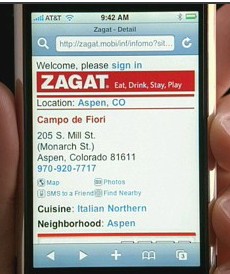
Krum: A pointed question, but I like it! I don’t think it necessarily conflicts with MY message, but I do think it is in direct conflict with the message that Apple is trying to promote with the iPhone about ‘one web.’ I would hope that Zagat.com works just as well on an iPhone as Zagat.mobi does, since the ‘one web’ thing is supposed to be their unique selling proposition. I don’t own an iPhone, so I’ll have to check it out and see. I honestly hadn’t seen the commercial, but it creates some serious cognitive dissonance, and that cracks me up. My guess is that Zagat started developing their .mobi very early in the game, before everyone realized that the separate site wasn’t going to be necessary in the long-term. Now that they have already put the time and money into creating it, they will probably continue to maintain it, until it becomes totally obsolete, or just not worth the effort.
Domain Name Wire: Can you give an example of a company using the “one web” approach in their web site?
Krum: Anyone who does not have a separate mobile website is defacto taking my advice, which makes me feel pretty good! The more important question is ‘who is really leveraging the options available to make one site work really well on both traditional and mobile computers,’ and that is a harder questions. There are a lot of ways you can update your existing website to work well in both rendering situations, but none of them are fool-proof yet.
You can draw a parallel between where we are now with the mobile web, and where we were 8-10 years ago with the traditional web. Between 1998 and 2000 was when the different web browsers really began to render things in a similar, predictable way, and that is what we are seeing on the mobile web now. My advice, if you are updating your existing website to work on mobile devices is to try to create a good mobile experience on a lot of different devices, rather than trying to create the same experience on a lot of different phones. Mobile phones and browsers are changing so rapidly that it really doesn’t make sense to design to a specific handset or browser. Instead, follow XHTML development standards, test and tweak on a variety of different devices, and expect the mobile experience to improve rapidly in the next year or two.
One of the best example I have seen is Wikipedia. They are doing a great job of using CSS to guide how the page will render in a variety of different situations. In general though, the people who are actually doing a really good job optimizing the .com’s are the people who have tried the other options and now see the long-term branding value in just using the .com. A blended approach is still appropriate, so as long as The AccuWeather.com is great for mobile though they also have a WAP and a Wireless subdomain. Twitter is also doing a great job without a .mobi, though they do have a mobile sub-domain, which is not totally inline with what I would recommend.




When I said this, people thought I was crazy…
Oh, gee, now you’ve gone and done it…just wait ’till the Dotmobilies and DotTVers read this. 😉
the headline implies that .mobi’s are a short-term fix, however, they are even less than that since they have no actual useage or functional benefit over a normal .com.
@ jn – yes. The article suggests that .mobi domains have a short lifespan, perhaps it could have been more clear.
This lady shouldn’t be marketing for any business. She contradicts herself with almost every word that comes out of her mouth. I’m all for a good discussion on the future of mobile, but get your facts straight by doing more research before you open your mouth.
Ms. Krum says that “the web is an invisible repository of information, that should be the same, regardless of where you are accessing it from or what type of device you are accessing it with” and then turns around and suggests providing a different experience for different devices. .mobi was designed to state that you have a mobile site, not that we are going to provide you with the most stripped down experience you can have on the mobile web. In time the “Suggested” practices for a .mobi domain will change, but it doesn’t make sense to change those practices to something similar to an iphone when less than 5% of the phones in the world would be able to view that content at this time.
Ms. Krum believes the iPhone is Gods Gift to the world yet she doesn’t own one herself or has even seen the commercial with Zagat.mobi. I would be happy to discuss this issue on traditional web vs. mobile web or .mobi vs device detection because I think it is important and can see benefits on all sides. But, please don’t continue to preach something you haven’t put the time into research and obviously don’t understand.
The blue moon website speaks about useability in saying, “[i]t is crucial that users are able to find what they are looking for when they arrive at your website.” I wonder in hypothesizing whether there should be One Web or a Full Web if Blue Moon truly understands what the Mobile Web is about. Why are there terms “Mobile Internet” or “Mobile Web?” Should we abandon those as well and just call this the Web or Internet on the mobile device, or are we going to look at the realities of projected use by users on mobile devices..
Just a little more knowledge because I have actually done my research. The majority of Ms. Krums former clients who she claims to have done work for have made the decision to build and utilize a .mobi site.
According to Ms. Krum’s logic, Google is breaking the “one web” concept by using Google.org for its philanthropic goals rather than Google.com.
What she fails to understand is that the extension – whether it be .org, .co.uk, or .mobi in this case – instantly communicates to the consumer what kind of site lies behind. In the case of .org, it’s normally a charity, NGO, or non-profit. In the case of .co.uk, it’s a local site from the UK. In the case of .mobi, it’s a mobile site.
It’s such a simple concept yet some people completely fail to grasp it.
There is still “one web”. There are just different ways of accessing the exact same “invisible repository of information”. The .mobi’s aren’t being hosted on a separate “internet” with servers on Mars.
Always give users the choice. If they’re on the iPhone and want a full-blown version of a site, they visit the .com. If they want a straight-to-the-point mobile version because they’ve only got 15 minutes before they catch their next flight, they visit the .mobi. Simple.
Lastly, let us not forget how much .mobi has done to grow the mobile web. Ms. Krum should compare the number of mobile websites there were before .mobi and how many there are today. That alone has made .mobi a success as it has significantly helped drive the growth of mobile content, something which has benefited everyone.
Hmmm…I actually think she does the best job I’ve seen laying out exactly why .mobi isn’t needed. And she’s done her research; after all, she’s presenting this at SES.
You don’t have to agree with her, but she makes some good points I hadn’t thought of before:
“It is important to note that iPhone users are the second most active users of mobile web in the United Sates, (just behind RAZR users); they are five times more likely to access the mobile web than users on any other phone.”
“You can draw a parallel between where we are now with the mobile web, and where we were 8-10 years ago with the traditional web. Between 1998 and 2000 was when the different web browsers really began to render things in a similar, predictable way, and that is what we are seeing on the mobile web now.”
Andrew, I think you see her for much more than what she is. The majority of her former clients all chose .mobi. The reason she doesn’t like .mobi is for seo purposes only. She obviously doesn’t feel she can get a .mobi site moved up in the search engines without being able to flood the page with tons of text and goodies. Her marketing philosphy lacks creativeness which is more desirable to clients than any SEO.
I guess it doesn’t matter “who she is”. The point is the arguments, which are well laid out. Of course you can disagree, but it does make sense that on cell phones of the future (including a few current models) you won’t care if you go to .com or .mobi.
And I’ll tell you this. Unless we get to the point VERY SOON that you can feel reasonably certain that typing domain.mobi in your mobile browser brings you to a web page…it will die on the vine.
It’s funny you mention that. Are you happy going to parked pages that will never be developed on the majority of premium .coms?
This is definitely a controversial issue, and I am happy to see lots of people engaging the debate. I would like to clear up a couple points that have been brought out in the comments or may have been unclear in the article.
1. In the same way that I believe the ‘.mobi’ will soon have outlived its usefulness; I also believe that terms like ‘mobile web’ and ‘mobile internet’ are limited with regard to usefulness and clarity. We are forced to use the terms ‘mobile web’ when we are trying to convey something about the rendering differences between traditional computers and mobile phones, but as those differences continue to decrease, the phrases ‘mobile web’ and ‘mobile internet’ loose their value.
(I know when I am going to do a search on my mobile phone, I never say “let me check it out on the mobile web,” but I do say “let me check it out on the web.”)
2. There are a variety of different ways to provide a mobile experience without using a ‘.mobi,’ and these tactics are better for search engine marketing because they allow you to keep all traffic, links and history with one site, rather than splitting them between two. The ‘.mobi’ extension doesn’t offer anything unique to a mobile user, other than an extra character to type on a tiny keyboard with your thumbs. In most cases .mobi’s are not ideal for SEO, and can actually hurt your branding efforts, and cost a lot of money.
3. I don’t own an iPhone, but I do believe that the iPhone has set the bar for what a good mobile browsing experience will look like in the future. I also know that many other handsets are vastly improving their browsing experience to mimic the iPhone. Since mobile handsets are usually replaced every 1-2 years, it is reasonable to assume that a large portion of the US will be accessing the web from mobile devices with a rendering experience similar to the iPhone in the near future.
4. Just as an FYI, I never claimed that any of the sites mentioned in the article were my clients. I just thought they were interesting mobile solutions that didn’t require a .mobi.
I am really enjoying the back and forth that is happening in the comments and hope it will continue. Also, if you want to learn more about my views on this matter, I encourage you to join us in San Jose at the Search Engine Strategies conference. My session is called Death of the .Mobi, and I expect there to be a lot of great discussion on the topic.
Marc – the point is that I’m more likely to get a mobile version of a popular web site by going to domain.com than going to domain.mobi. Heck, Cnn.mobi doesn’t even resolve.
Cindy, do realize how bad this very website looks on my nokia n95? I need some way of knowing a site will display well on my phone. DotMobi works.
Paul: and you intend to keep your n95 for how long? Why do you need a way of knowing a site will display well on your phone? if it just works as it is, you don’t need to bother, and that is how it should be.
Wake up, things will change, and things change FAST in Internet/Telecom business, you have only seen the beginning with iPhone, and it’s only the beginning.
If it’s not the future, it’s already dead. You need to look further than 1 year ahead in this industry.
Which do you think is better for an iPhone user:
1) a site designed for a 15″ screen that requires zooming, pinching, and panning,
or
2) a site designed specifically for the iPhone’s 3.5″ screen that requires neither?
(An example of a site specifically designed for the iPhone is http://SportsTap.mobi)
Please advise and justify your answer.
@ Anonymous – I’ll let Cindy respond to that.
But why do you need .mobi to optimize for a 3.5″ screen? Many major web sites can determine if a visitor is on a phone and automatically forwards them to a mobile version of the web site. Wouldn’t it reduce confusion if people just typed in .com and the server sent them to the correct site? After all, my domainnamewire.mobi domain actually just forwards to .com, which then shows a mobile site if you are on a mobile phone.
@Bobo – Why do I want to know what sites will display well on my phone? So I don’t waste time waiting forever for sites to load that look like garbage. I’ll keep my N95 for quite a while, 3G, wifi, 5 mp camera. Very nice phone.
@Andrew – You don’t NEED .mobi to optimize for a 3.5″ screen (about 2.5″ in my case). The value in mobi for me is knowing before I visit that it will work. That’s what it’s about. Other mobile naming conventions exist, mdot, mobiledot, /mobile, etc… For existing PC sites offering a mobile version that is their prerogative. But you’ll see more and more .mobi sites coming that are only focused on the mobile market without a .com counterpart. Consider Disney’s http://HSM2.mobi (no hsm2.com counterpart), a mobile focused site for High School Musical 2. Also services like http://pilot.mobi (no pilot.com counterpart), offering maps and directions that work on most any device unlike google maps which won’t even load on my phone. .mobi offers a platform that CLEARLY indicates that this site’s focus is on mobile web. The other naming conventions can even cause confusion. For example, mtv.com loads ok on my phone with a tailored mobile site. mobile.mtv.com is a full PC site selling ring tones. But I thought mobiledot was supposed to be for mobile…confusion. .mobi tells me the site will work on my mobile before I visit it. I find value in that and I’m not alone.
Daily I browse ESPN.mobi and weather.mobi. I know they work and give me the content I want. For search I use google.mobi and find.mobi. Google’s results are pretty weak unfortunately for mobile users, mostly PC sites so I’m trying find.mobi. There is no perfect solution but I get the warm and fuzzies when I find a .mobi site on my phone, I know it works.
dotMobi is NOT technology, dotMobi is NOT a platform. dotMobi is just a domain extension, with a ton of creative marketing behind it. It was never needed and it still isn’t, no matter what any overly-defensive dotMobi investor says.
To make your site render on the small screen, you need just two things: a script for device detection (a few lines of code), and a alternate stylesheet (again, just a few lines of code). Then you can run it all just using a domain.com format. There are sites out there that already do this (MSNBC and Facebook for example). No .mobi, m., mobile., or anything else needed.
The interview above reads like a simplistically .com centric view of the web. People outside of the US are used to dealing with more than one extension and often the dominant extension is the country code top level domain (ccTLD) in mature markets. While .mobi is a niche extension it has a far clearer definition than most other gTLDs. Having a device specific extension is actually a good thing. The .mobi extension is still a relatively new one and it has not gone through the Junk Dump yet. This is the anniversary of the landrush when a lot of the the highly speculative domains will be dropped. To write off .mobi this early is quite foolish.
The web is not an “invisible repository of information”. It does not look the same on all devices nor should it. Some people browse with text only browsers. Others use audio based browsers. The web, for the most part is still a text driven medium. Most of the developments of the past few years have been towards making it more graphic and interactive. The .mobi extension is, in some respects, providing an interface that is more text driven. Some people seem to have a problem with that.
The .mobi extension, being device specific, theoretically allows the user to access the information in a manner that is compatible with the interface (the mobile device). It is the difference between fullscreen streaming video on a widescreen 19 inch monitor and SMS text message. They cater for different parts of the market and different devices.
Cindy, with all due respects, it is just your opinion and you have not provided any statistics to back up any of your arguments.
@phil – a few lines of code? Disregarding this gross under-exageration, how will I know a site has done this?
@Paul
The site owner informs their users how to access their site: “please visit our site at domain.com.”
It’s called promotion. Something mobi fanboys should know something about.
@phil – you don’t seem to understand, how do I know BEFORE visiting a site that it is optimized for mobile?
BTW, why are you making this discussion personal? I’m not “overly defensive” nor a “fanboy”. I’m simply raising reasonable questions.
Most people will still type in .com even when accessing the web from their mobile.
And I apologize. I was directing the “defensive” comment at one of the previous posters. Ms. Krum has a different opinion on the .mobi extension. Because of that @marc says that she shouldn’t be in the marketing business. Give me a break!
@Phil – That wasn’t my question, to reiterate, how do I know BEFORE visiting a site that it is optimized for mobile?
So all those new tld’s that Icann plans on releasing next year are needed of course but .mobi is not. Wow!
@ Paul – but how do I know before I type in domain.mobi on my mobile browser it will resolve? It’s the same issue. Are odds higher that I’ll get a mobile optimized site if I type in .mobi or .com, including all of the times .mobi doesn’t even resolve?
@ Fred – I don’t know many people think that those other TLDs are needed. And what happens when someone tries to challenge .mobi by coming up with a short mobile extension, like .mob? I think the alternative extensions like these will be hurt badly when the next extensions are introduced.
@Andrew – .mobi websites need to comply with the dotMobi style guide found here http://dev.mobi/files/dotmobi_Switch_On_Web_Developer_Guide.html
Also you can visit http://ready.mobi to test sites in comparison to the mobile website recommendations.
The goal is a namespace that provides a specific focus on mobile web. Not all sites are perfect but so far for the most part if it’s a .mobi website it works pretty good on my mobile phone.
What’s ironic is that with all the hype surrounding the iPhone and it’s ability to view “regular” websites, if you visit the various iPhone website directories, the sites in large part look like .mobi sites. It’s great to be able to view full sized sites but it’s far from ideal.
Your right though in regards to directly navigating and typing in a random .mobi website, the current amount of content is thin. But it’s growing for sure, more and more each day. Ultimately though most people find content via search. When I scan results I’m looking for something that tells me this is a mobile friendly site, .mobi is a great indicator.
Paul, I think it’s crucial for .mobi to work with the top 100 sites on the web to get them using .mobi, even it if just forwards to their existing mobile site. CNN owns CNN.mobi, it’s just not forwarding it.
I don’t design websites for different mediums/browsers, I don’t make one for FireFox, one for IE, one for different resolutions, one for Televisions, one for laptops, for phones/PDAs. Nor should I have to.
Thank god we passed the old days when needed to make separate versions for IE and Netscape, because some idiots couldn’t agree/following a standard. That time will never come back.
@paul: I can follow recommendations for making a site mobile-friendly without being forced to use a special TLD for it. You should check out CSS “@media screen” property. More information here on W3C from 2005 explaining device independence: http://www.w3.org/Talks/2005/0513-CSS-WWW2005/all.htm
Andrew, I understand your point on this in terms of pubic awareness. I can’t speak for CNN and why they keep their .mobi door closed. They are using mdot and don’t support mobiledot either. Fox uses their fox.mobi, as well as foxnews.mobi. Ultimately no single approach has been adopted by everyone so users are left to fend for themselves. Some sites use auto detection, some use mdot, some use mobiledot, some use wapdot, some use .mobi and some use other names. iphonedot is one of the latest I’ve seen lol! What’s next, bbdot for BlackBerry’s? As a mobile web user I’m looking for something to provide me an assurance of a good experience. The 3 that have been most predictable are .mobi, mdot and wapdot. The other naming conventions or auto detection are a crap shoot.
To use a PC analogy, imagine if you knew that 95% of the live sites built on .org would not load correctly on your PC, set to 10,000 pixel width with enormous amounts of content on one page requiring you to scroll all over to try and find what your looking for. Reminiscent of reading old newspapers on microfiche screens if you’ve ever had the dubious ‘pleasure’. Would you not be apprehensive to visit them? This is my experience on mobile with most .com sites I find in google search results. It’s utterly frustrating, time and again the sites won’t load or look like garbage on the small screen when they finally load. I want some way to know the site will work well. Some want to blame my device but that is not the problem. When a site is one big Flash window or is set to fixed width 1200 pixels it’s DOA.
If every webmaster on earth would agree tomorrow to rebuild their sites to be device independent then there would not be any need for .mobi or any of the other mobile site naming methods but we all know that isn’t going to happen.
@bobo – I’d say we’re still in the old days to some degree, it’s still debatable if it’s safe to abandon the box model hack so designing around browser problems will seemingly always be an issue. And today in mobile the differences are vast. I’d love to not have to deal with these problems but they exist regardless and .mobi is a viable solution among others.
You can absolutely follow the recommendations for making a mobile friendly site without using a special tld. Only a fool would argue otherwise. The issue comes back to how does a user know it’s mobile friendly when the norm in .com is that sites are not mobile friendly?
Also again I think there is a difference in perspectives related to existing websites vs new businesses focused on mobile web. If I wanted today to go and build a mobile website for Tampa, what would be the ideal domain? Arguably the “best” domain would be Tampa.com but it’s not for sale and if it were it would be sold for several hundreds of thousands of dollars. On the other hand Tampa.mobi was bought for a minor fraction and developed into a nice site for mobile web users, while Tampa.com looks horrible on my phone.
Most of the .com namespace has no intention of adapting to the mobile context, rather they expect devices to do the job for them. But even the iphone proves that people want content adapted to the mobile context. This is providing an opportunity for .mobi site owners to exploit this growing mobile market.
It has been implied that there were inconsistencies within the logic in the article, but I think there may be a misunderstanding. What I support, in terms of a good mobile experience and a good SEO strategy, is combining browser sniffing with a multiple style sheet solution. With that solution you have one set of information with multiple sets of rendering instructions and the experience is tailored to the device that you are viewing the website from. Even if you don’t employ that type of mobile solution, you can create a mobile subdomain or sub directory on your website without sending traffic to a .mobi or compromising your SEO efforts and branding strategies.
Some have commented that .mobi sites are appropriate for ‘mobile-only’ sites that are not intended for use on the traditional computer. That is an interesting idea, but in my opinion, it still doesn’t justify the domain extension. Even if your target market is mobile users, that doesn’t mean that they will never visit your site from their home computer or laptop. (What if they want to print something off your site or take a screen shot?) I don’t think the fact that your primary target market is ‘mobile users’ is a valid justification for the domain extension.
One of the questions that has come up a lot is “how do I know a site will render on my mobile phone if they don’t use a .mobi?” and the answer is this: Even with a .mobi domain, there is no guarantee that the site will render well on your phone. No one is out there policing .mobi domains to ensure that they are adhering to a universally accepted set of guidelines or development standards. Even a .mobi site can still have serious problems rendering on different mobile devices.
In the near future, traditional .com sites will render well on mobile handsets because mobile browsers are universally improving their rendering capabilities. Mobile browsers will get better at transcoding traditional sites for viewing on mobile handsets without side to side scrolling or zooming. The current complaints about screen size and side-to-side scrolling hearken back to the early days of the internet where sites were built to specific screen sizes and browsers. In those days, if you had a different screen size or used a different browser you had a bad experience on the site. The good news is that those problems have been addressed on traditional browsers, and as the internet continues to evolve, they will soon be addressed by mobile browsers too.
@Cindy,
Your recommended solution for device detection and style sheet switching can work just fine for existing sites if they can figure it out and convert all their content appropriately. Those flash screens are out, all those graphics need reducing and I’m not sure what to do with all that javascript. By the way, redirecting to a subdomain robs SEO just like a .mobi site could. A subdomain is a completely different URL to the search engines. No bots I know of yet are trawling the web for mobile subdomains but they trawl the list of registered .mobi’s. A clear advantage to .mobi over subdomains. Not sure what to do about sites that go through all the hassle of auto detection and still get caught by a carriers transcoding engine. All .mobi’s get white-listed but the rest are a crapshoot. I guess the webmaster enjoys keeping track of all the carriers in the world that might deploy transcoding and making sure their site is white-listed there. Nothing like building a gorgeous mobile site and having a carrier mess it all up trying to “help” their users.
If you are still debating the creation of .mobi that ship has sailed. .mobi exists today and you can either use it or ignore it. You clearly want to ignore it, I respect that is your prerogative. Many however are embracing it and unfortunately you seem to want to also ignore why. For those people with a mobile-only focus it is ideal. And so what if a PC user visits a .mobi? They can view it too if it’s built appropriately.
Also to your comment: “One of the questions that has come up a lot is “how do I know a site will render on my mobile phone if they don’t use a .mobi?”” … You didn’t really answer the question. To state it in the positive, “How do I know a site will render on my phone if they use .com, .org, .net, .co.uk, etc…?” The answer today is a user has no clue unless they try it on their mobile. The simple truth is that most sites look bad on mobile devices which is why the concept of a mobile namespace was created, to set some coding standards that embrace the needs of the wide spectrum of mobile devices.
Your subsequent comments suggest that you are ultimately relying on the phone browser technology to solve all the problems for you. What happened to the multiple style sheet solution? You really can’t have it both ways, either you need to design for the mobile medium or you don’t. Which is it?
Very well said Paul. My sites are designed for mobile but can be viewed on a PC as well. They look good on a PC (not spectacular), but they serve a purpose as well. Feel free to take a look at AtlantaWeather.mobi which has been up for two weeks and is currently second on yahoo for the phrase Atlanta Weather Update out of 16,100,000 results and in the top 100 already for Atlanta Weather 119,000,000. I have similar results for the first 25 markets I have launched in that two week period. I really haven’t done a lot of SEO yet besides tags and haven’t done any other marketing because the other 42 markets aren’t quite ready. So….my point is, it isn’t that hard to move up in the search engines with a little work even if you are using a .mobi.
.mobi was designed for mobile businesses. You being in the marketing industry yourself know that you can’t always take an existing storefront business and toss it on the internet and expect results. You have to tailor the new business or create a new business associated with your current storefront to achieve the best results and not take market share away from yourself. So, if I have a furniture store, then maybe I start a bedding store online where I can create another business without having to build another physical location and just keep some inventory in my warehouse or dropship from another dealer. The mobile web is no different. Then you have to ask the question, what might people need while they are out of home that relates to furniture and can make me more money. Maybe it’s a site called MattressSale.mobi where people can compare your sale prices against other stores while they are out shopping. You could even use a tag line of….”Check out the others, but take us with you”. This isn’t the most thought out on the creative side of things but I hope you get the idea. I have suggested to my clients that it is ok to take their business mobile, BUT..what can you offer them that is different from your current business but can supplement it as well without taking market share from yourself.
In my opinion, it is rather short-sighted to rely on device detection and multiple stylesheets when that technology may:
(1) not exist at all on a given site
(2) be set up improperly by the webmaster
(3) be blocked by technological gatekeepers
I tried all summer to use the Major League Baseball mobile site and kept getting errors instead of baseball scores.
Furthermore, several mobile telecom companies already are assuming .mobi means mobile and .com doesn’t. They’re voting with their technology by employing transcoding on all tld’s except .mobi. They are stripping out the header information that directs the browsers to the secondary stylesheets and instructions.
Before you say it’s impossible, Vodaphone U.K. and Sprint PCS in the U.S. are doing this right now. For .com you need to be added to a special whitelist for the telco’s to leave your header information alone. For .mobi, your site is automatically exempted from the transcoding. So, do you want to write to every telco and get on every whitelist so they will leave your header information alone? I can’t imagine the administrative nightmare those whitelists are going to be once more .com webmasters start writing in to claim their spots.
What does this transcoding look like? On my site, mobienthusiast.mobi (July 24th post) I have actually gone through the process of taking a high graphics site through transcoding via mURL.mobi to show what it would look like. It’s not a pretty picture. There are gray blocks all over the place, the pictures are still to heavy to load quickly, the site would still require horizontal scrolling — it’s a mess.
The bottom line here is that you have a marketing solution to what will soon be a very big problem when more people start visiting the internet on their phones. Only one tld is actively working to solve it at the top level of the registry, and that is mTLD – and .mobi.
I agree with Cindy Krum. What she says make perfect sense.
I’ve seen countless .mobi sites that are not mobile friendly (not even remotely).
Just do a search on Google
“Site:.mobi”
There is only one web no matter what.
Some people just have mobile devices/browsers that cannot parse out the website very well.
It’s a device/browser problem, and the solution is being made.
Cell phone and its browsers are constantly browsing. Data plans are getting cheaper.
It’s only a matter of time before majority of the cell phone owners have user friendly device that will be capable of parsing out full web.
sorry I meant to say Cell phone and its browsers are constantly improving.
Thanks for your comment Steve, but could you please tell us which sites don’t resolve? By saying go to google and type “Site:.mobi” doesn’t say which ones don’t resolve well on a mobile phone.
The percentage of users who are tired of zooming and scrolling for 20 seconds trying to find what they are looking…sorry I mean viewing the PC version of a .com are about 2% right now. Thats pretty good for the two years of existence of .mobi. So yes, I agree with you that it’s only matter of time before users will be capable of viewing the full web on their mobile phones. At this rate that will put us about the year 2020. So please don’t do anything mobile at this point until the majority of users can use your site and those of us will .mobis will just keep doing what we are doing and take more traffic away from you.
Hi Marc,
Can you provide evidence/fact/link for the percentage % and other numbers?
or are they your opinion?
Also, feel free to take all the traffic to your .mobi site.
Here’s just the first page on google for “site:.mobi”
full web sites
http://registratordomena.mobi/
http://www.mp8.mobi/
http://www.chillies.mobi/
http://www.16888.mobi/
http://www.sarin.mobi/
http://www.ambassade.mobi/
http://www.motorhomes.mobi/
http://www.bannertausch.mobi/
http://www.turfiste.mobi/
http://agaricus.mobi/
Those numbers were released about a month ago. If you do a little searching you can find it pretty easy. They are definately not an opinion. I would love for all phones to be able view whatever content users wanted. Unfortunately that is not an option at this time.
You forgot to tell me which sites you were talking about that didn’t resolve?
Cindy Crum appears to be having one of those arguments that is akin to arguing which route to take to travel half way around a ring road (such as the M25 orbital around London)…. she says anti-clockwise and I might say clockwise… but in reality it is a pretty pointless argument; not because one is right or one is wrong but it depends how you travel? what time of day? are there road works? is the weather bad? is there a major event enroute? – before you ask what relevance this all has – I’m suggesting that there are many variables that affect the situation; visiting a dotcom site on a mobile can be either a headache or a pleasure depending on whether the site is mobile compliant.
As Holly says, efforts at compliance are only as good as good as the weakest link in the chain; if the Telco has different ideas as to what you should be seeing you won’t get a great mobile experience..
Of course, you can visit dotmobi’s that aren’t fully compliant or don’t resolve… there will always be those examples but if you follow the trend there will always be a far higher % of sites on dotmobi that resolve well on a small screen than there ever will be on any other extension because there are 25 years of detritis on the internet we use today..
Ms Crums argument is no more valid about disregarding dotmobi as it is to disregard every extension other than dotcom..
“Of course everyone wants a dotcom” is an arrogant and ignorant assumption to make… outside of the USA the focus on dotcom is far from that found in the USA, I’m not sure why that is – probably has a lot to do with the delay between the USA discovering the internet and getting their countrycode dotUS.
News for Ms Crum… The mobilenet is a new phenomena, it is about a hand held small screen internet.. of course it will allow you to view ‘all the net’ but there is a difference between what people want & need on the move as to what they want sat at their desk (or kitchen table)…
The truth is that “dotmobi” is about branding mobile content as being just that… “mobile content” Now if Ms Crum is going to advise all her clients that their customers want the W3 squeezed onto a small screen then dotmobi isn’t really what she’ll be using…
I would be advising clients to make ‘made for mobile’ content – new promotions, price updates, availability, latest deals & offers.. fun & games, news.. all sorts of quick & easy content that’s useful, fun, entertaining etc.. don’t forget the devices will almost all have GPS within a short while.. splendid news for location specific updates… and flash lite… on it’s way now..
Whats not to love about dotmobi?
Last comment: Have you noticed that desk -tops are becoming ‘media centres’ and they are now all ‘widescreen’!!
This is in direct contrast to mobile devices – yes they have widescreen format now – but at 3.5″ at their widest point (on a high end device) that leaves a developmental headache for those planning to use the same content on a 3.5″ screen as a 21″ wide screen… what do you suggest? pocket size magnifying glasses sold as accessories for your smart phone? (whatever technology can do, it can’t rush development of the human eye – natures been perfecting that for 10’s of thousands of years… unless Cindy has lined herself up as the 2nd coming? (in which case I humbly apologise 😉
All listed above except for motorhomes.mobi haven’t resolved or got an extremely poor score through ready.mobi/ mtld emulator.
Marc, where were those numbers released?
“I would love for all phones to be able view whatever content users wanted. Unfortunately that is not an option at this time.”
There are phones like iphone that can view whatever content users wanted with some restrictions and exceptions due to limitation in technology at the moment.
It will happen nonetheless in the near future in my opinion.
My last comment for the day.
I hope for the best to .mobi and mobile internet.
I don’t want any investors to lose money.
I must admit that some of the active .mobi sites are looking pretty great.
Marc, I wish you the best with your site.
I like it.
Take care.
@Steve A high percentage of .mobi is parked. A lot of this is due to the practice of hosters automatically pointing unused or undeveloped domains to their PPC/Parking pages. The .mobi is still a relatively new extension and it has not gone through the Junk Dump (Landrush anniversary) yet. It is still developing as an extension. However a high percentage of any gTLD will be parked as well.
@Cindy Without statistics, all we have are your opinions. While this artificial controversy is great at getting publicity for your talk at SES, the lack of a fact based argument (as opposed to one based purely on your opinions) is highlighting the very different nature of SEO in .mobi TLD. It is only natural that SEO businesses will tend to concentrate on what they know and it is in their own interest to write off any new development that poses a threat to their existing markets. Your hopes for the development of mobile technology seem to ignore the way that technology develops. The screen size on the mobile is still a limiting factor and will remain so until a projection system that allows a mobile to display a web page at the same resolution as a PC monitor. And even so there will still be the majority of the mobile market that will depend on old technology. Some mobile data subscription plans are based on the volume of data downloaded. The .mobi extension allows site owners to create a mobile friendly version of their site (or a new website) that will display on a mobile device. The mobile friendly sites tend to have less of a data footprint thus making them cheaper for the user.
The .com centric nature of your opinions ignores the whole ccTLD (country code top level domain) part of the web. Taken to the extreme, your argument is that .com site owners should ignore the ccTLDs and concentrate on serving modified pages to visitors from these countries. And yet companies operating in these countries will prioritise their ccTLDs over .com. What you seem to miss is that there is no “one web”. There is a set of markets. Some markets are global and others are niche markets. The mobile web (and its extension .mobi) is one of these niche markets. It will grow slowly at first and the more it grows, the more people will claim that the old ways were better. But like the shift from landline phones to mobile phones, it is a natural progression of technology. And the markets always find a way to make money from innovations – even if it is with controversially themed conferences proclaiming the death of these new technologies and markets.
Steve, I know your last comment was mainly for Marc but I must say it’s so nice to see a debate that can end with a ‘hand shake’ & not spitting feathers (an old English phrase 😉
Fair play to you..
You may want to cut & paste the following link… it’s just an example of the many good reasons not to dismiss that the mobilenet is a future phenomena rather than the W3 but mobile.. good luck to all who have businesses in this area.
http://news.bbc.co.uk/2/hi/technology/7522305.stm
Well folks, .mobi continues to be a divisive topic. It’s almost like McCain v Obama 🙂
I suppose we won’t know who’s right until this all plays out.
I appreciate Cindy taking the time to provide well-articulated arguments for her side, even if not everyone agrees with them.
The saying goes;
“there’s more than one way to skin a cat”
Quite apt… as there are numerous methods of tackling this issue depending on what your intentions are, needs are & user base is….
I like the spin off opportunities it presents; pages within your main site can be built for mobile and spun off with their own direct navigation via a dotmobi domain name… hosting is pennies, ultimately flexible and can be used for all manner of marketing purposes…
for example Mars might use 50 dotmobis for 50 of their products…. snickers.mobi – each site giving a resume of product history, ingredients, nutritional value etc.. along with current offers and promotions (save 6 tokens for a disney toy) etc etc…
Marketing is easy… advertise url and say goodbye to forgetting what you saw when you drive by a billboard & get 200metres down the road…
lets be honest; if you can’t recall snickers.mobi then you’d be pretty dumb 😉
@Cindy…”the phrases ‘mobile web’ and ‘mobile internet’ loose their value…(I know when I am going to do a search on my mobile phone, I never say “let me check it out on the mobile web,’ but I do say “let me check it out on the web.’)”
Sure YOU can say that, but when the usage news is reported and mobile whitepapers come in, they will need to say what the analytics are from the mobile web.
Its really like coffee and iced coffee, you may call them coffee when looking at them, but when ordering and using them, they have different names and suit different purposes…
.mobi and the discussion of it is directly connected to the internet divide. Spend an hour on google insights for search and see vast parts of humanity not even exist on a globe.Talking about the reign of .com has the smugness of talking about how Bismark carved Africa
Let’s assume for one moment that all arguments for dotmobi are invalidated 100%
(although that is far from my belief)
Let’s assume that those who adopt dotmobi do so for purely cosmetic / aesthetic reasons…
Let’s assume that an unspecified percentage of mobile users will type in dotmobi address ‘on spec’
Let’s ask ourselves a question… if we have mobile compliant content (which I think we can all agree IS going to happen anyway)
The only question is this;
Would I choose not to spend $50 a year on having a dotmobi to use at the very least as part of a ‘catch all’ strategy?
Traffic isn’t cheap & isn’t easy… if 5 percent or 75% of mobile traffic comes via dotmobi – wouldn’t you spend $50 a year to capture that traffic?
And that argument isn’t as vacuous as say; using the same argument for utilising a dotbiz extension to ‘catch’ random traffic.. I truly believe that dotmobi will be an essential part of accessing the mobilenet – it is not a ‘dead in the water’ extension like dotbiz etc..
Gary, I don’t think anyone would advise against paying $10 or so to get your .mobi. But people are paying $10k, $20k, and more to speculate on .mobi domain names.
Andrew,
You are somewhat misguided if you think that those with $20,000 invested in dotmobi are being ‘hoodwinked’ into backing the extension..
It is not an investment for widows and orphans but the again Andrew there are $Billions traded each and every day… so $20,000 to us is (I assume) a lot of money whereas to some players it’s literally ‘fun money’
Dotmobi is at the beginning of it’s life cycle… by number (not necessarily duration) the majority of web visits will be made from a mobile device within 5 to 10 years (in Japan this is already true).
Dotmobi makes sense, countrycodes make sense and dotcom makes sense… .org has been bastardised by too many ‘non organisations’ using them (but it still makes sense)… dotnet makes sense (as 2nd fiddle to dotcom) and dotinfo? what’s that all about??? what is the internet if not a resource of information?
Dotmobi is affordable for those needing a mobile web presence… reg fee plus renewals.. it makes total sense.
Aftermarket? who knows if $5,000 for a name is way under or way over ‘true’ value?
Time will tell… but I’ll agree on one thing with you..You & I may not see it the same way but neither of us knows how it will end?
There could well be some very wealthy investors in 5 years time… or there could be investment write-downs / write-offs but in a climate where you can’t even trust bricks and mortar as a guarenteed investment, I’m happy to speculate with a % of my assets being in dotmobi domains..
Gary, I was responding to your $50 comment.
But yes, we don’t know how this will end. It’s speculative, but perhaps the speculators will be rewarded.
I realised that Andrew but the day to day practicalities & logic of using dotmobi are a separate entity entirely to the speculative side of the domain industry.. let’s be honest, most small to medium businesses acquire their main url by registering it themselves, even beyond that most sales in the aftermarket are low-ball.. it’s only an elite group that trade in the many 10’s of $1,000’s… even in dotcoms..
So ignoring the speculation – I find very little not to like about dotmobi… all the arguments are by people who argue that you don’t NEED dotmobi & then continue to fight as if just for the sake of fighting against using it.. when the truth is that using a dotmobi has zero down-side and an unknown upside; when the stakes are this one sided and the budgets so low, I can’t understand why anyone would bother to argue against it… any consultant employed to tackle this question is going to charge more for an hours pontificating the question than an entire years costs of adding dotmobi to your site access ‘choices’
Seems kind of dumb to waste the money on the consultant in such a trivial way when there’s so much work to be done delivering the right content to mobiles…
The iphone needs mobile apps the same way that my HTC does.. it is not a coincidence that the dotmobi compliance is exactly what mobile sites should be like regardless of dotmobi or not… ready.mobi / device Atlas dev.mobi all very well thought out resources for the mobilenet.. if anyones that stubborn just build a site that scores 4/5 to 5/5 on ready.mobi & stick it on a dotcom & call it http://www.whatsitandmacwhirterandsons.com/mobile if you must but at least get the site scoring 4/5 or 5/5 because that’s what matters..
I’m seeing a robust trade in aftermarket names right now.. the prices have hit a bottom but volumes are most definitely picking up..
I’m looking forward to the next 12months..