





An explanation of Demand Media’s deal with Donuts

SEC filing sheds (some) light on relationship for new top level domains.

A lot of fuss has been made about the connection between Demand Media and Donuts and the new TLD program.

What exactly is the relationship between the two companies? Demand Media’s latest 10-Q, filed today, explains the terms of the agreement:

As part of its initiative to pursue the acquisition of gTLD operator rights, the Company has entered into a gTLD acquisition agreement (“gTLD Agreement”) with Donuts Inc. (“Donuts”). The gTLD Agreement provides the Company with rights to acquire the operating and economic rights to certain gTLDs. These rights are shared equally with Donuts and are associated with specific gTLDs (“Covered gTLDs”) for which Donuts is the applicant under the New gTLD Program. The Company has the right, but not the obligation, to make further deposits with Donuts in the pursuit of acquisitions of Covered gTLDs, for example as part of the ICANN auction process. The operating and economic rights for each Covered gTLD will be determined through a process whereby the Company and Donuts each select gTLDs from the pool of Covered gTLDs, with the number of selections available to each party based upon the proportion of the total acquisition price of all Covered gTLDs that they funded. Gains on sale of the Company’s interest in Covered gTLDs will be recognized when realized, while losses will be recognized when deemed probable. Separately, the Company entered into an agreement to provide certain back-end registry services for gTLD operator rights owned by Donuts for a period of five years commencing from the launch of Donut’s first gTLD. Demand Media is not an investor in Donuts nor involved in any joint venture with Donuts or its affiliates.

Note the last line of the explanation, which may have been added to diffuse any suggestions of a tighter relationship between the companies.

So far Demand has made $18.2 million in capital investment in the new TLD program, most of which was paid to Donuts. The company’s $185,000-per-application fee for its 26 own TLD applications represents less than $5 million of the capital investment.

Demand has already incurred formation expenses of $4.3 million through the end of March related to new TLDs. It expects up to spend an additional $5 to $10 million on formation expenses in 2013.

In a somewhat unrelated note regarding to the company’s 10-Q, it appears there’s an error in its filing. The filing refers to the cost of .com domains and Verisign’s latest agreement with ICANN. The note in the 10-Q says the new agreement allows Verisign to hike prices 7% in four of the six years of the contract. That’s not the case; the prices are fixed for the term. I suspect this information was inserted when the contract was agreed to by ICANN but before the Department of Commerce got involved. It was never updated after the final agreement was inked.


How Demand Media sees its domain name business

Domain business positioned as end-to-end domain provider, spin-out on track.

Demand MediaDemand Media just concluded its first quarter earnings conference call, and much of the talk centered on new TLDs.

The company is working to spin out its domain name business into a separate business and expects that to happen by the end of the year or in early 2014.

CEO Richard Rosenblatt explained that the company wants to be an end-to-end provider of domain services. The group will continue to own its own portfolio of domains, hold an expansive distribution network, and provide services to buy, sell, and monetize domains.

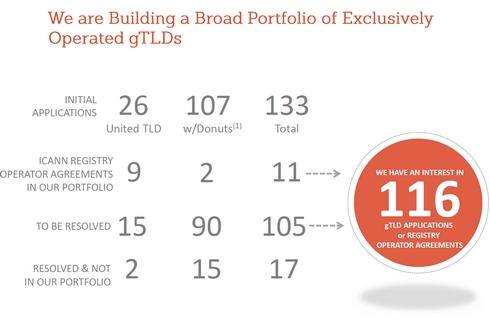
Demand Media applied for 26 top level domains and has rights to up to 107 more domains that were applied for by Donuts. The company thinks its first new TLD may come online as early as Q4 of this year based on ICANN’s current timeline.

Rosenblatt said he likes the registry model because it’s higher margin than selling domains as a registrar.

When prompted by an analyst, he said the company should reap the benefits of slotting fees when more TLDs start competing with each other. Slotting fees, sometimes part of marketing programs, are fees domain registries pay to show up higher in domain check results. Demand Media may also determine it is better served to slot its own domains higher and forgo some slotting fees.

The company said that 40% of its revenue in the first quarter came from Google. It will be interesting to see how that is split out after the domain business becomes a separate entity.


Demand Media touts new TLDs in latest earnings, domains increase to 14 million

Demand Media puts new TLDs front and center in earnings release.

Demand Media just released its first quarter earnings. It reported a slight profit of $0.7M before adjustments.

But more interesting to the domain world is the focus the company’s earnings release places on new TLDs.

The first paragraph proudly announces that the company has signed up 400 resellers for its new TLDs (though eNom) and has received 2 millions “expressions of interest” from people interested in registering particular new TLDs. You can think of these expressions of interest as good leads for the company once new TLDs finally come out. (The 2 million number was announced by the company previously.)

Demand Media’s domain name business ended the first quarter with 14.0 million domains under management, thanks to the Name.com acquisition.

The registrar business made up 35% of Demand Media’s business in Q1, down from 37% in the same quarter last year.

The company is exploring spinning off the domain business.


Demand Media passes a new TLD Initial Evaluation

Company passes initial evaluation despite rule about UDRP losses.

Demand Media’s new top level domain company, United TLD Holdco, has passed the initial evaluation stage on one of its TLD applications.

The company passed the initial evaluation for Fish.com .fishing today.

Demand Media was the biggest question mark amongst big-name TLD applicants with regards to if it would pass initial evaluation.

Part of the initial evaluation is the background check, and passing this requires that the applicant not have three or more UDRP losses in the past four years:

has been involved in a pattern of adverse, final decisions indicating that the applicant or individual named in the application was engaged in cybersquatting as defined in the Uniform Domain Name Dispute Resolution Policy (UDRP), the Anti-Cybersquatting Consumer Protection Act (ACPA), or other equivalent legislation, or was engaged in reverse domain name hijacking under the UDRP or bad faith or reckless disregard under the ACPA or other equivalent legislation. Three or more such decisions with one occurring in the last four years will generally be considered to constitute a pattern.

Demand Media subsidiary Demand Domains has many UDRP losses.

Of course, I suppose United TLD Holdco is not Demand Domains…


Demand Media sets up Dublin office for domain services

Company makes formal announcement about operations in Ireland.

Demand Media announced today that it is opening its international headquarters for the company’s domain services business in Dublin, Ireland.

Demand Media is serving as the backend registry provider for its own top level domains (applied for under United TLD Holdco Ltd.) as well as Donuts’. United TLD has applied for 26 top level domains and Donuts has applied for 307. Of course, many of these domains are in contention sets.

In its applications for new TLDs, the company noted that Demand Media Europe Limited, based in Ireland, would be its backend registry provider.

The company has hired David Ryan, formerly a senior director with Electronic Arts, as General Manager for the Dublin operation. It plans to hire 20-40 people within the next year.


Next Page »


TOP